How Each Country Divides Their Currency

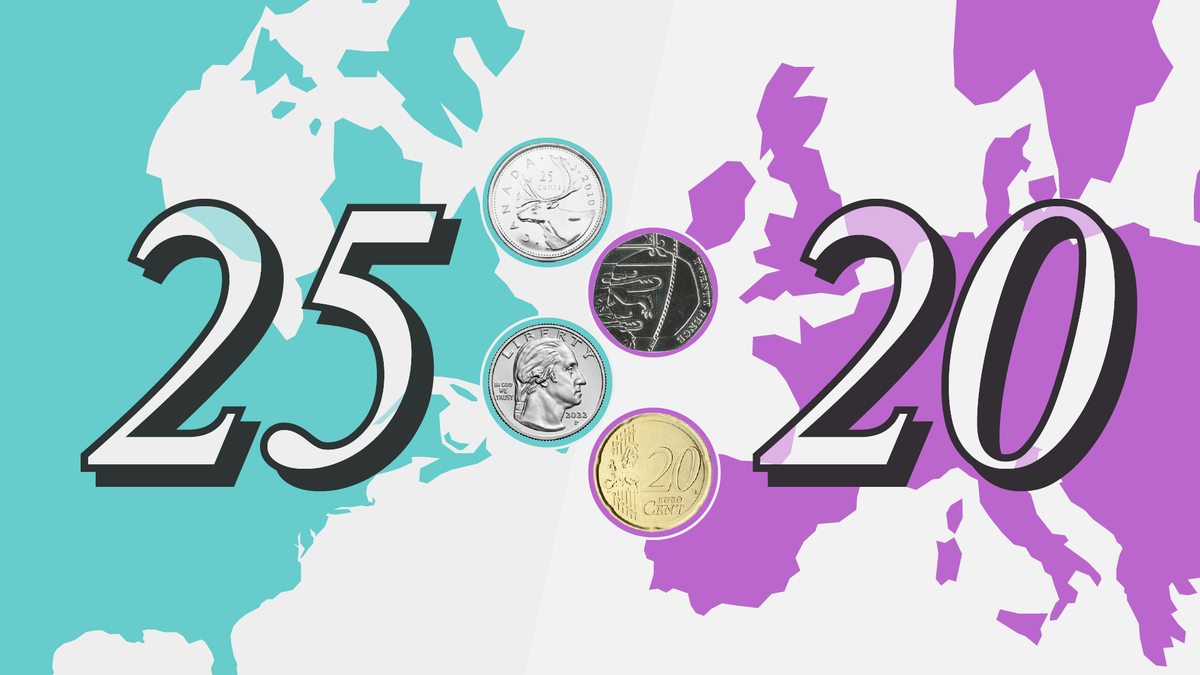
After over a year without getting any new ideas for maps, I suddenly got struck with inspiration to make one again! I was rewatching CGP Grey's video about nickels for no apparent reason, and in it he said that the quarter is "the most American coin" because most countries divide their coins into fifths instead of quarters, and I wanted to check if this was actually true.
The examples Grey provided were the US dollar (which splits into quarters) and the Euro (which splits into fifths), which both still use cents. I live in the Dominican Republic, which doesn't have cents (anymore), but we do have a coin worth 25 pesos, which I count as fitting into the quarters category. I applied this to the currencies of every other country and territory*, and I put them all in this map!
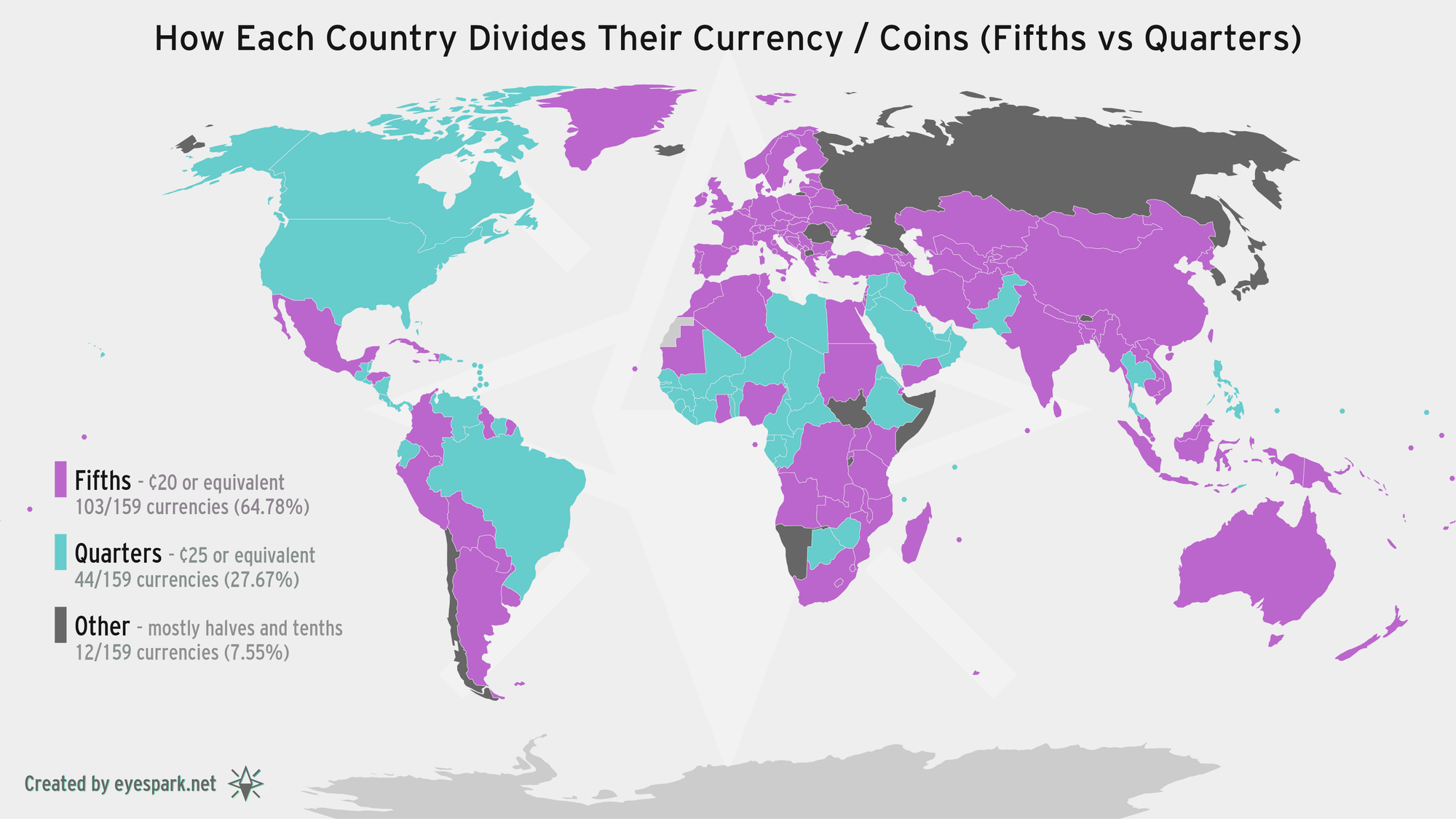
Most currencies are divided in fifths rather than quarters, just like Grey said. Fittingly, only about a quarter of them are divided into quarters, with a good chunk of these being in North America.
Before making this map I thought that there would be a bigger correlation with colonization, but ultimately there doesn't seem to be, as a lot of countries don't have the same system as their former colonizers. This could be in part due to the influence of other countries that came later (like with the United States), or alliances and economic blocks between multiple countries (like all the countries in the African Financial Community), but again, it definitely varies from case to case.
There's a dozen currencies labeled "Other", meaning that their system doesn't exactly fit within the firm "quarters or fifths" system of the rest of the map. The Burundian franc, Chilean peso, Icelandic króna, Japanese yen, Namibian dollar, Romanian leu, Somali shilling, and South Korean won only have coins with denominations of 10 and 50 (or equivalents), so they fit into their own category of halves and tenths. The Macedonian denar and Russian ruble also fall into that category, but they also have coins with a worth of 2. Lastly, the Bhutanese ngultrum and South Sudanese pound have coins worth 20 and 25.
Additionally, these don't impact the actual data, but I do want to add that the Azerbaijani manat, Bahamian dollar, Cook Islands dollar, Cuban peso, Kyrgyzstani som, and Tajikistani somoni are the only currencies in the world to have coins and/or notes with denominations of 3, so that's fun!
I do have to admit that this map might not be entirely accurate. Some of these currencies don't have cents, and so I sometimes used higher denominations that are equivalent to cents, which I assumed from my own experiences with the Dominican peso. If anybody from any of these countries thinks the label I put for them is inaccurate, please contact me about it, as I'd like to keep this as accurate as possible! I'll also leave this Google Drive for the spreadsheets I used for both the countries and currencies, so it might be easier to find stuff that way.
Regardless, this was a nice return to these informative maps! I haven't made a new* one since January 2025, and I feel lucky that my geography knowledge hasn't faded whatsoever, as I didn't have issues with locating countries and stuff. It was quite fun!
… Or was it?
I did say I didn't have issues with making the actual map itself, but that doesn't mean this was easy to put together. This map has taken me over 10 hours to make in total, including the time I've spent gathering the information itself, which I'm pretty sure is a record for any map of this kind I've ever made, and I'm going to disclose all of these issues now. If this stuff interests or matters to you feel free to continue reading.
Like many things having to do with "countries", the big issue is what do I count as a currency?
My base for this project was Wikipedia's list of currently circulating currencies, and I also used the UN's list of currencies (by exchange rate) and the list of ISO 4217 currency codes.
Firstly, the Wikipedia list included four currencies from states that aren't recognized by the UN and don't have ISO 4217 codes. I decided not to include these to remain consistent with my other maps, but I will still mention them here: The Abkhazian apsar, Somaliland shilling, Sahrawi peseta, and Transnistrian ruble. The last two have quarters, the Somaliland shilling has fifths, and the the Abkhazian apsar has both 20 and 25 apsark coins.
The other issue is with pegged currencies and external territories. I originally didn't count these, but I ultimately decided to do so. Some of these don't appear in the UN list but do appear in Wikipedia and/or the ISO code list, and I decided to include them to have some variety, but only if they minted their own coins for common use.
The Cook Islands and Niue are two states in free association with New Zealand, meaning that they aren't fully sovereign nations. I counted the Cook Islands dollar as it has its own coins and notes that are printed regularly, but I didn't count the Niue dollar as it only has a few purely-commemorative coins minted. It's also just classified as the New Zealand dollar in both the UN and ISO lists, along with the Pitcairn Islands dollar. The same applies to the Faroese króna which uses Denmark's coins.
Meanwhile, there are two fully sovereign UN-recognized countries that have their own currencies with unique coins that aren't in the UN's list and don't have their own ISO code, being the Kiribati and Tuvaluan dollars. It feels weird to disagree with the literal International Standards, but I decided to included them on the dataset.
Lastly for currencies, there's the Crown Dependencies of the United Kingdom (Isle of Man, Jersey, and Guernsey). The three all have their own coins which are pegged to the Pound sterling, and although UK notes are legal tender in the Crown Dependencies it doesn't apply the other way around. They don't have ISO codes, despite being in the same currency union as some overseas territories of the UK with their own codes, but I decided to count them as they do print their own coins that are in regular circulation. There's also the Alderney pound, which is part of Guernsey, which I decided not to count as only commemorative coins of it are printed.
That's pretty much it! Yeah, this addendum is longer than the main post itself, but I felt like this was all important to disclose.