How Many Currencies Share the Same Name?

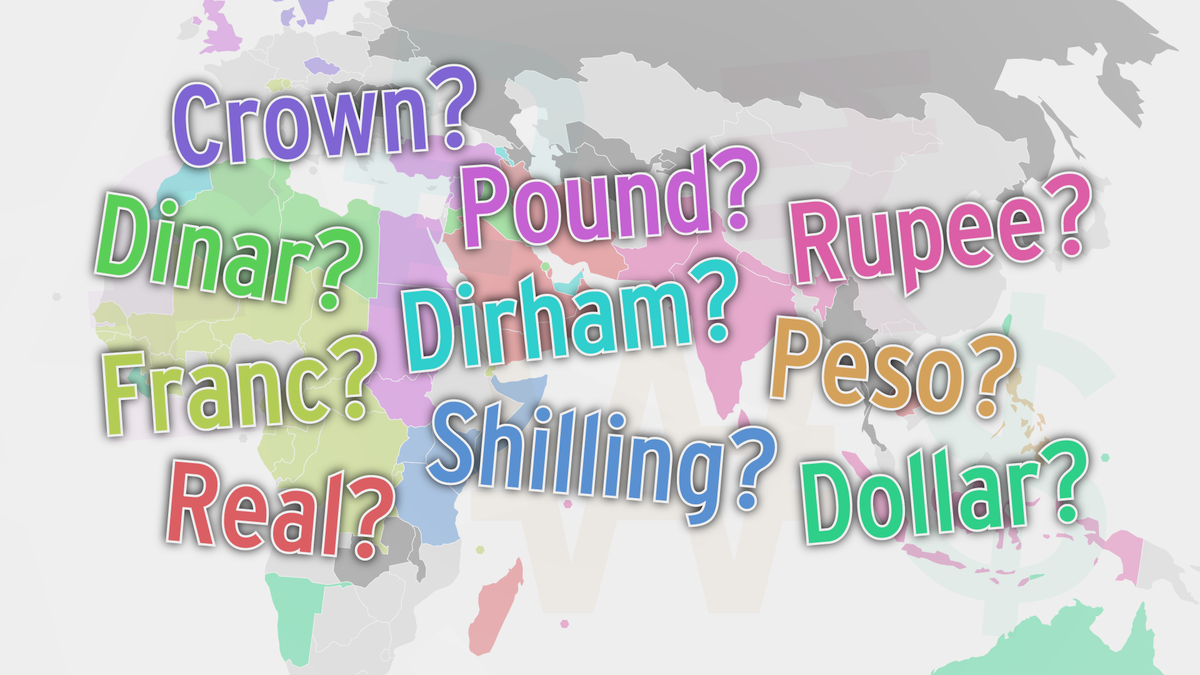
After I finished my previous map about how each country divides their currency, I watched a video by RobWords about how a lot of currencies got their names and symbols, which I highly recommend you check out! It's very well made, has lots of interesting bits of information, and it even mentions multiple theories for the ones we aren't 100% certain about, which I always appreciate.
Anyways, after watching it I got the idea of making a map of how many currencies have the same name! (i.e. how many currencies are called dollars). Unlike the divisions map, this one was quite straight forward, as I started with the currencies that had the exact same name, and then verified the ones that didn't. (My source was the same as the previous map)
There's some Wikipedia pages of currencies that use the same name which sped up the process, I then looked up every other currency individually to check the origins of all their names, and I grouped together the currencies that had the exact same. Something important to note is that some currency names have something in common with other currencies, but I didn't group them together unless they had a direct connection. I'll elaborate on what that means later on.
But now, without further ado, here's the map itself!
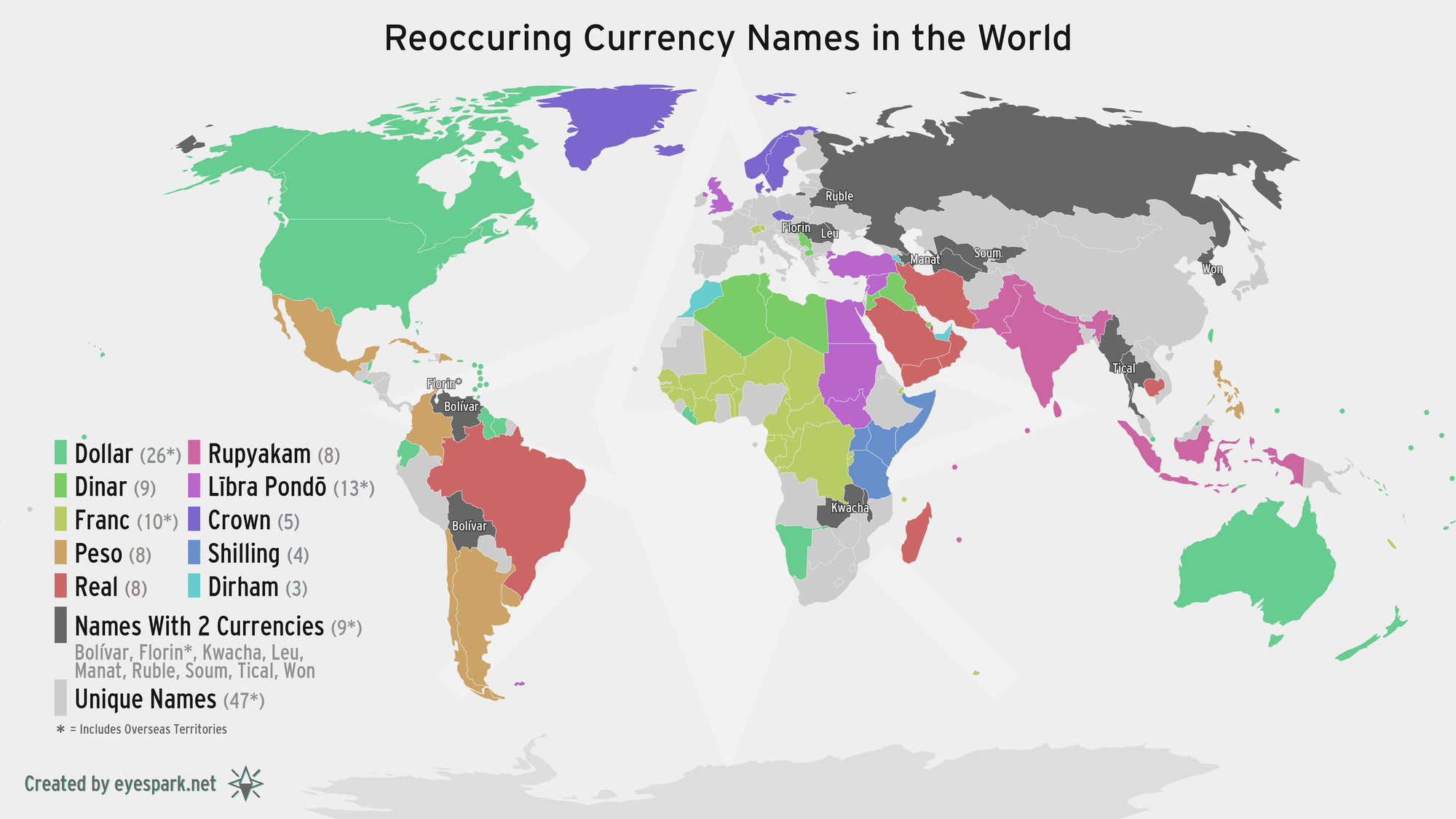
I'd love to go into detail about every single specific name, but that'd take way too long, so for now here's my spreadsheets for the map which features a quick note alongside each currency explaining their name. They are extremely brief, so I do recommend researching them yourself if you're really curious! A lot of these are also explained in more detail in RobWords's video.
There's 19 names/origins with multiple currencies in common, but only 10 of them have three or more currencies. The most common is the dollar, which is the name of 26 currencies, including the Samoan tālā, which is the Samoan cognate of "dollar".
This might also be a good place to elaborate on what I mentioned previously about a name's origin. The dollar comes from the old Bohemian joachimsthaler coin, which went on to be used in Spain and their colonies and then the United States, where it spread from there. However, there's two currencies, the Romanian and Moldovan leu, that come from a Dutch variation of the thaler called the leeuwendaalder (lion thaler); I could group these with the dollar, but since they're from a very specific variant of it, I counted them as their own thing. I applied this rule to every other name with an origin related to another.
Moving on, the next most common currency name comes from the old Latin term for a pound of weight, lībra pondō, which is where we get the Pound as well as the Turkish lira. This one's heavily boosted by the addition of currencies from the United Kingdom's Crown Dependencies and Overseas Territories, as only 7 currencies of sovereign states originate from the lībra pondō.
The third most common name is the Franc, which is the name of 10 currencies, though it's actually used in more countries than the lībra pondō (25). This is mostly because of the fourteen countries in the African Financial Community, which all use the currency (albeit in separate West African and Central African variants), as well as a few other countries. The franc originated — perhaps unsurprisingly — from France, both of which were named after the Frank people, though the currency specifically probably came from an inscription in old French coins. The only remaining users in Europe are Switzerland and Liechtenstein.
Lots of other coins' names come from older currencies, some originating from the area, but most are from other places due to trading or colonialism. There's the Franc and Dollar of course, but there's also the Dinar (from the Roman dēnārius coin), the Real (old Spanish and Portuguese coin, though in the Americas only Brazil uses it now), the Shilling (old British coin worth a twentieth of a pound), the Dirham (from the ancient greek δραχμή [drachma] coin), and the Soum (from the Kyrgyz & Uzbek word for the Soviet ruble).
Other coins are named after a specific unit of weight, just like the Pound from the lībra pondō. These include the Peso ("weight" in Spanish, used across Hispanic America, plus the Philippines), and the Burmese kyat and Thai baht (which comes from the Tical unit of weight from Southeast Asia, roughly 15 grams).
Here's some more rapidfire origins:
- Rupyakam is the general Sanskrit term for a silver coin, from which we get the rupee, as well as others like the Indonesian rupiah and Maldivian rufiyaa.
- The Aruban florin and Hungarian forint come from the old Florino d'oro, gold coins made in Florence. From variants of these we also get the Caribbean Guilder and Polish złoty (form the Dutch and Polish words for "golden" respectively).
- Lots of European currencies are called "crowns", specifically those of Denmark, Sweden, Norway, Iceland, and Czechia.
- Some currencies in East Asia are named after the roundness of coins, like the (unique) Japanese yen, and the Korean won, which is a cognate of the Chinese yuan, all of which mean "round". (Important Note: While the main unit of the Chinese currency is the Yuan, the currency itself is called the renmibi, which stands for "the People's Currency". For the purposes of this map/post I'm counting the name as Renmibi.)
- The Kwacha used in Malawi and Zambia comes from the Chewa word for “it has dawned”, which is unusually beautiful for a currency. Plus its subunit is called a tambala, the Chewa word for rooster, who famously announce the dawn.
- The Manat used in Azerbaijan and Turkmenistan comes from the Russian word for coin, монета (moneta).
- A few currencies are named after people, most famously Venezuela's bolívar and Bolivia's boliviano, both named after Simón Bolívar, the Venezuelan military officer known as the Liberator of South America. There's also Tajikistan's somoni, which I originally thought came from the soum/Soviet ruble (just like Kyrgyzstan and Uzbekistan's currencies), but it's actually named after Amir Ismail-i Samani, an Islamic ruler in Central Asia in the 900s.
- The term ruble itself is of unknown origin, though one theory suggests it comes from the Russian verb рубить (rubit), meaning "to cut".
Just short-ish descriptions of a fraction of all these currencies took over 600 words. Can you see why I didn't want to talk about all of them in this post? Again, if you found this interesting I really recommend doing your own research! Or at the very least checking out my spreadsheet for the minimum information.
Learning about little details like these makes me appreciate the world a lot more. There's so many interesting details in almost everything out there, and all you need is an attentive-enough eye and open mind to find some stuff that is truly fascinating.