Fruit Ninja Not-So-Classic

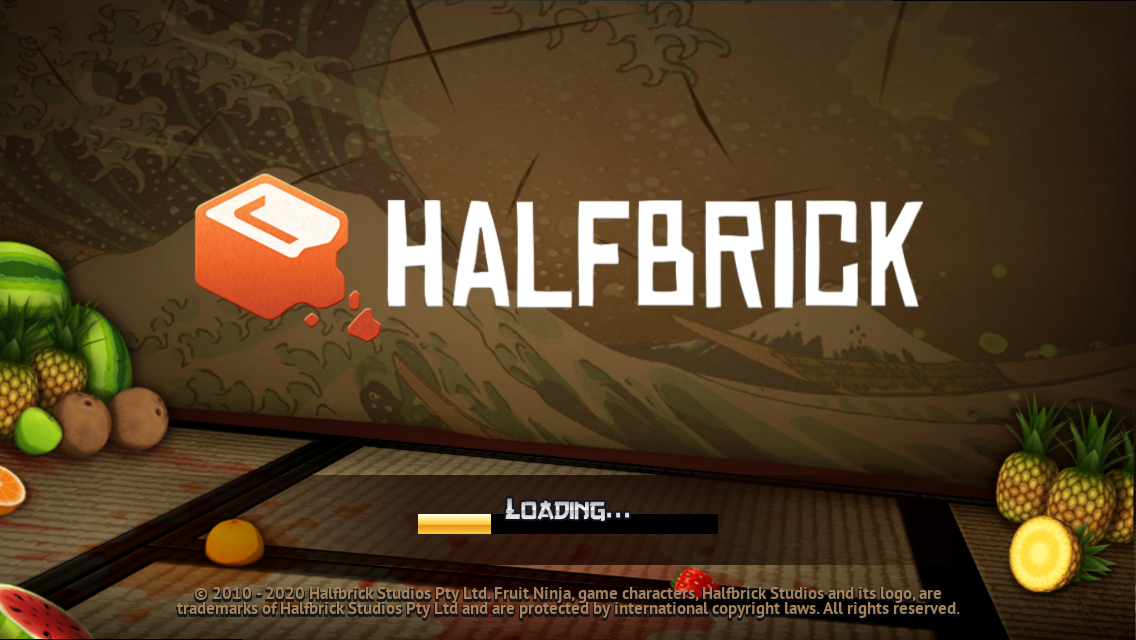
I've mentioned before that I've been messing around with the iPhone 5 on iOS 10 recently, and I've been playing some games that are no longer playable, or even older versions of games.
The last available version of a game varies a lot, but for one specific game the last available version on iOS 10 is from 2020: Fruit Ninja Classic.
This edition of Fruit Ninja doesn't feature any ads or microtransactions, but does require a paid subscription to Halfbrick+ or Apple Arcade to play. My disdain for subscriptions aside, it is still a very enjoyable version of the game and I've been playing it a lot recently!
Its Google Play description states that you can "enjoy the thrill of Fruit Ninja and the nostalgia of classic games" with it. However, the version of the game you get is actually very new, and though it does have the vibe of older versions it has actually undergone multiple changes.
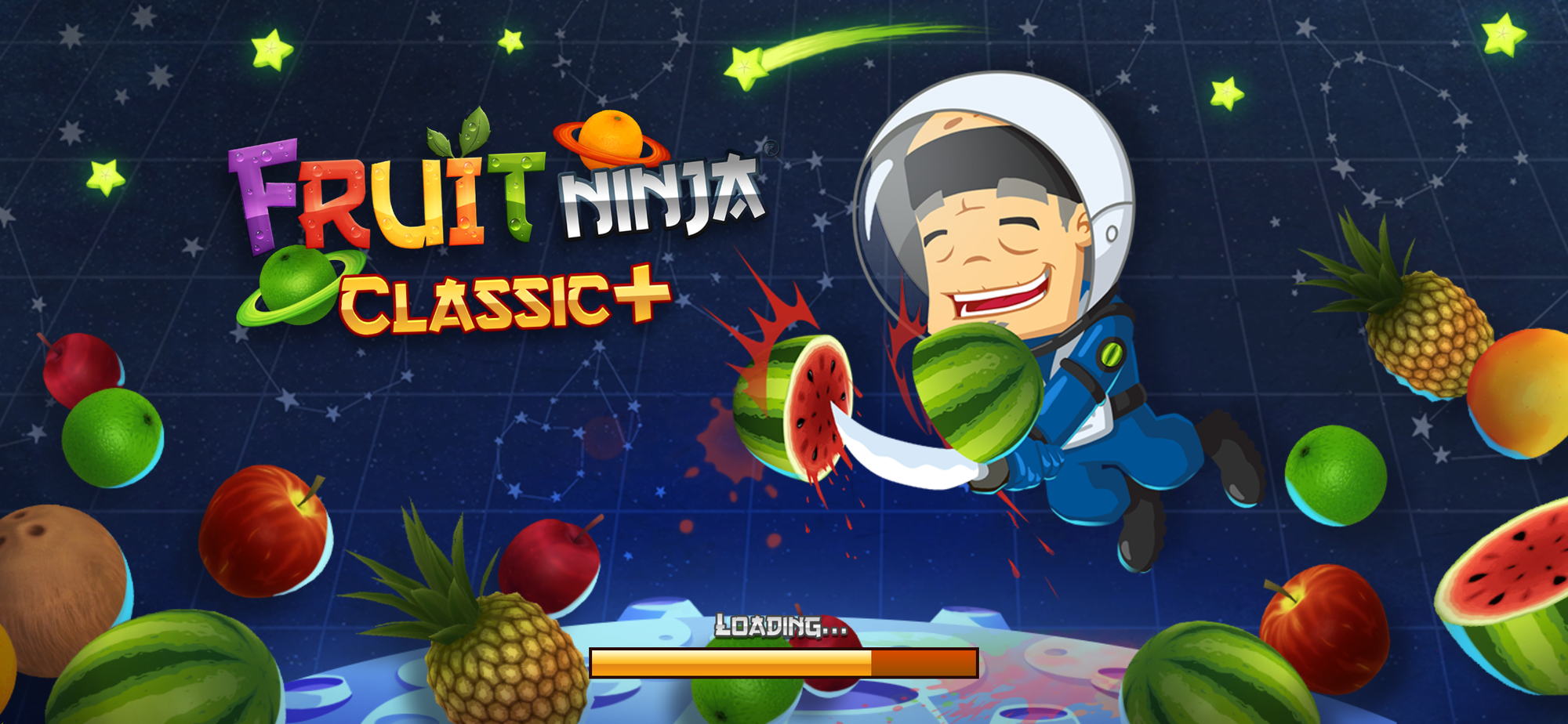
(I want to state here that I do really like this version of the game! I just find it silly that for being the "Classic" version it differs heavily from how the game was just 3 years ago)
In my mind there are three very distinct "eras" of the original game, and after doing some research I found that these do actually line up with the actual updates of the game, so it seems that Halfbrick themselves agree.
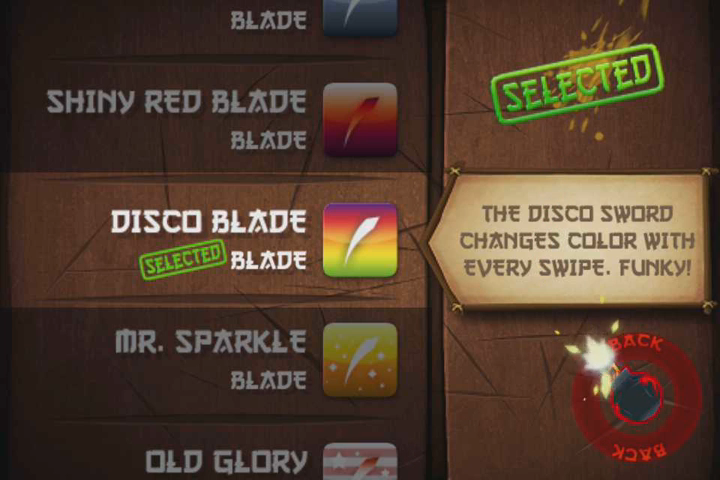
The Fruit Ninja I was the most familiar with and definitely played the most was the very first version, which I will call "Version 1". It lasted for almost 4 and a half years from the game's release on April 20, 2010, and ended once update 2.0.0 came out on October 2, 2014.
The main mechanic which separates this from the other versions of the game is progression. After the 1.3 update the game featured custom blades and dojo backgrounds, which were purely cosmetic. At first these were unlocked by completing certain achievements, and once Starfruits were added in 1.8.0 (the game's currency) they could optionally be bought with them too.
This leads to what I call "Version 2" of the game, which started with the release of update 2.0.0 on October 2, 2014, and ended once update 3.0.1 dropped on July 25, 2023. This version lasted almost 9 years.
Additionally, somewhere around this time the original "Free" version of Fruit Ninja became the standard version, and the paid version became Fruit Ninja Classic. I am unsure of when exactly this happened, but it is visible if you already had the games before they were changed.
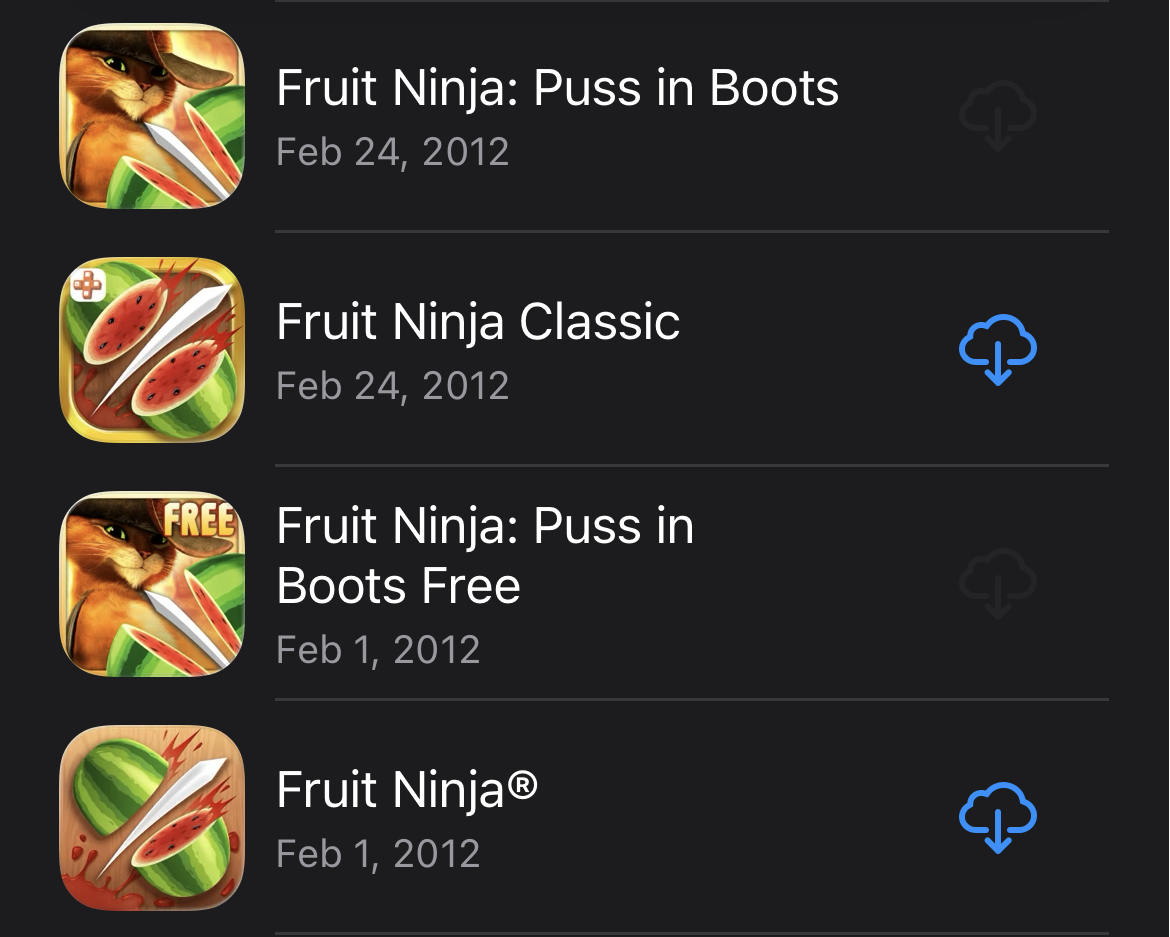
But regardless, the main change from this version of the game was that it reworked how blades and dojos worked in every single aspect.
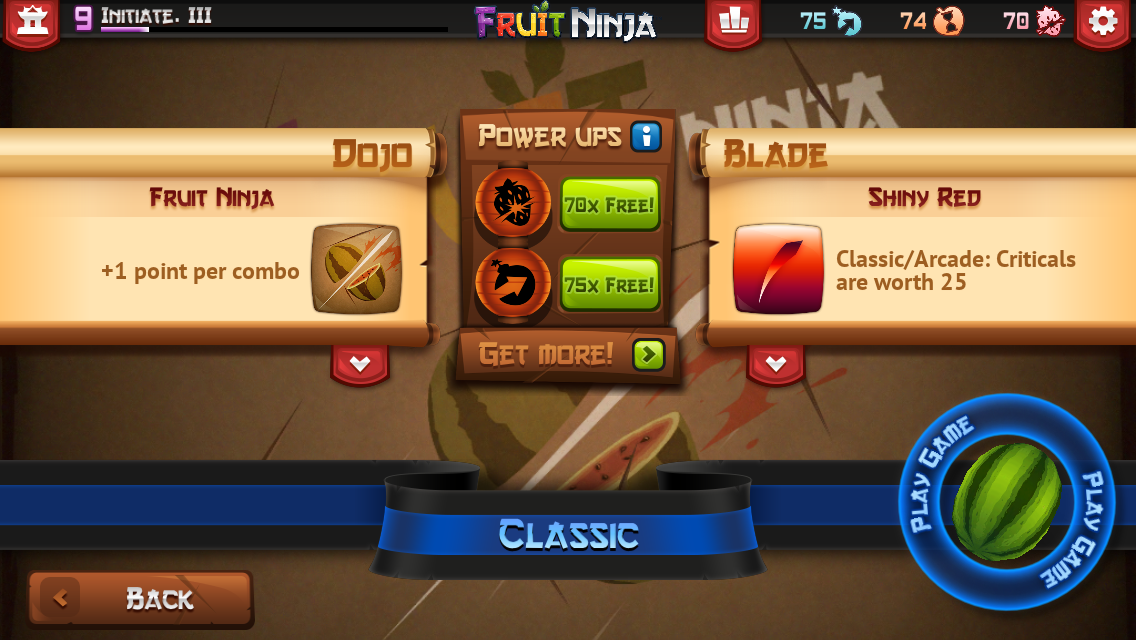
This update introduced an XP system, and so the only way to unlock new blades was to get enough XP by completing missions and generally playing, that would increase your level and unlock new dojos and blades. Additionally, they all actually featured unique abilities, so they weren't just cosmetics anymore and actually affected gameplay.
To give just two examples: the Shiny Red Blade was unlocked upon reaching Level 7, and had the ability that critical hits awarded 25 points instead of just 10. And the Great Wave background was unlocked upon reaching Level 12, and had the ability of randomly summoning large waves of 10 fruit that you could slice.
All of them had unique abilities in gameplay.
And lastly, now we go to Version 3, which as I said earlier started from the 3.0.1 update from July 25, 2023. This is the current version of Fruit Ninja Classic, and by the time it came out the game was already called that and part of the Halfbrick+ subscription service.
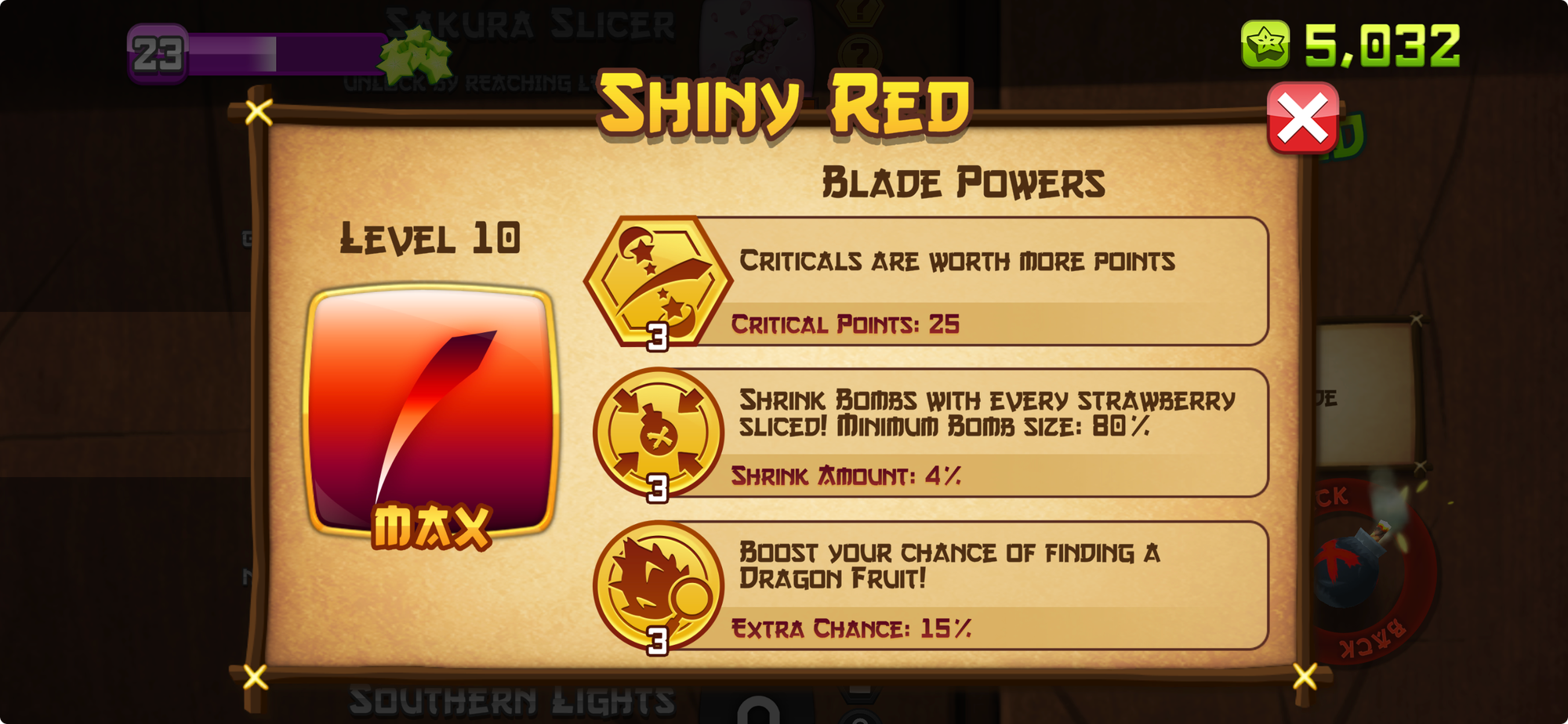
Aside from polishing up the look of the game even more than before (genuinely, it looks great now) this version brought the only other big change to the blades and dojo system after update 2.0.0. Now dojos do not have abilities anymore and are purely cosmetic again, but blades are much more powerful.
Instead of just one ability, blades now have three that you can level up to level 3 each, resulting in very powerful blades. For example, aside from the 25-point criticals, the Shiny Red Blade also makes bombs shrink when you slice strawberries, and increase the probability of dragonfruit appearing.
The upgrades themselves are pre-determined for each blade, but the order you get them in and level them up is completely random. Additionally, to level them up you need to pay some starfruit and have enough "duplicates" of the blades, which you get by a random Jetpack Joyride-esque wheel which you can spin if you get Spin Tokens while playing a game, which may give you stuff or not.
Regardless! It is quite a fun system. Although it is up to random chance how quickly you can upgrade, it fortunately doesn't take too long, and it does give you an actual reason to spend time using certain blades.
And that's about it! There isn't any big takeaway or opinion I have for any of this. I just wanted to info dump about a mobile game that I used to really love, and have found myself loving again! Both the current version and Version 2 on my iPhone 5.
I don't want to reveal any details yet, but there is something that might allow me to revisit Version 1 as well, and if it all works out I will probably talk about that soon.
But regardless, hope you found these small bits of Fruit Ninja history interesting! :
One last thing: Luke Muscat, one of the original developers of Fruit Ninja, made an amazing video talking about some of its development. Please check it out!